
Xuping Jewelry Wholesale Supplier Evaluation: Evidence, Not Promises
A jewelry wholesale supplier can be genuinely capable and still deliver late. Supplier evaluation therefore produces two separate judgments. The first is a capability judgment: what the supplier can do in general, evidenced by design staff, patents, factory scale, certificates and export markets. The second is a delivery judgment: what will actually happen to your purchase order, on your specification, on your dates, against your acceptance standard. The first is an input. The second has to be constructed, order by order.
This guide sets out a four-grade evidence ladder for evaluating wholesale jewelry suppliers, applies it to Xuping Jewelry, a fashion-imitation jewelry manufacturer and wholesaler founded in 1997 and based in Guangzhou, China, and closes where evaluation should close: at the purchasing terms, inspection criteria and exception procedures that turn claims into measurable commitments.

Capability and Delivery Are Two Different Questions
Capability is aggregate; delivery is specific. Xuping's supplied capability data states a monthly capacity of 8,000,000 pieces and a lead time of 30–90 days. Both figures are useful for screening a bulk jewelry wholesale partner, and neither answers the questions that decide whether an order succeeds: which production week your order is scheduled into, which inspection stage it passes through, and what happens to the schedule if a plating batch is rejected.
The more common evaluation error is scope substitution — accepting a document issued for one product or one market as proof for another. Certificates and laboratory reports name products, standards and validity periods. If the model you are buying does not appear in that scope, the document is background information rather than evidence for your order.
A workable decision rule is to interrogate every claim three times: what document proves it, what scope that document covers, and what order term it converts into. A supplier that answers all three with specifics is easier to hold to a delivery date than one that answers only the first.
The Evidence Ladder: Four Grades of Supplier Proof
Evidence improves when it is graded rather than collected. The ladder below separates what a supplier says about itself from what an independent document confirms, and both from what your own order verifies.
| Grade | Typical evidence | What it can support | What it cannot support |
|---|---|---|---|
| 1 — Self-description | Website, catalog, marketplace profile, sales deck | Shortlisting and category fit | Compliance status, capacity allocated to you |
| 2 — Third-party document | ISO 9001 certificate, SGS or CTI test report with a number | A management-system scope or a test result for the stated standard | That the exact SKU you are buying was tested |
| 3 — Scope-matched record | Report whose applicable product list names your model; documented case with market and volume | Fitness for a defined product and market | Performance on your dates and quantities |
| 4 — Order-level verification | Approved sample, pre-shipment test, inspection record, packing list, written order terms | Delivery assurance for that order | Future orders without repeating the checks |
Most supplier evaluations fail at the jump between Grade 2 and Grade 3. A report exists, so it is filed; nobody checks whether the tested model matches the item being purchased. The same gap appears in reverse: a smaller wholesale jewelry manufacturer may hold scope-matched reports for exactly the category you buy, while a much larger supplier holds a general certificate that never touched your SKU. Grade the evidence, not the brochure.
R&D Depth: What 150 Designers and 194 Patents Can Support
Xuping Jewelry reports an R&D team of 150 designers and 194 patents, supported by more than 1,200 production facilities within a 200,000 m² production base. For a buyer evaluating custom jewelry wholesale capability, that combination supports three things: design throughput on trend-driven ranges, iteration speed when a brief changes mid-development, and the ability to handle OEM/ODM requests that alter construction rather than only colour or length.
It does not support a cost, a minimum order quantity or a lead time for your specific design. A patent portfolio records what a company has protected; it does not state that a given construction will be tooled for your order, and the patents' relevance depends entirely on the mechanism you need. The practical test is to describe one design in writing and ask two suppliers to price and schedule it. A design team that cannot convert a brief into a sampling plan is a staffing figure, not a capability.
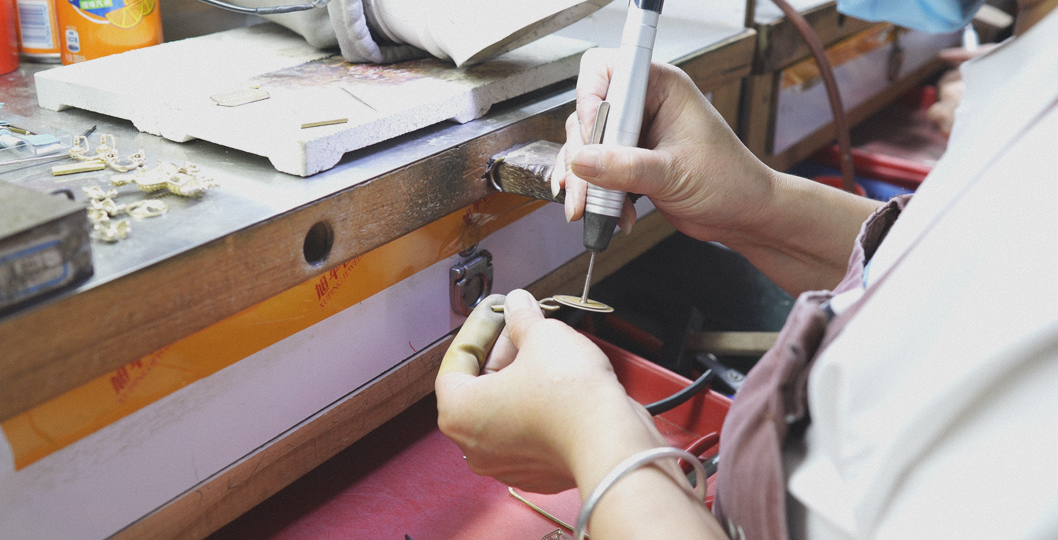
Ask for the sampling route in writing: how a drawing becomes an approved sample, who signs it off, and how long each stage takes. The supplied factory content units document pattern making, wax injection, hand carving, soldering, findings assembly, chain making and engine turning workstations, and the company profile states that goods pass through 18 production procedures. Those stages are what a sampling plan should reference by name.
Operating History and Export Coverage as Screening Signals
Xuping has operated since 1997 — nearly three decades in the same category — and reports a 100% export ratio. The listed markets span Europe (Spain, Germany, France, Italy, Poland, United Kingdom, Ukraine, Russia), the Americas (United States, Mexico, Canada, Peru), the Middle East (Turkey, Saudi Arabia, Iran, UAE), Southeast Asia (Philippines, Thailand, Indonesia, Malaysia, Vietnam), Africa (Nigeria) and Oceania (Australia, New Zealand).
Multi-market coverage supports a narrow but real inference: a supplier working across these regions has usually handled more than one documentation set, more than one labelling convention and mixed logistics lanes. It does not establish order volume in your market, current capacity allocation in your season, or compliance with your destination's requirements — all three must be confirmed separately.
Scale claims need the same treatment. The 200,000 m² facility and 4,000+ employee figures are company-reported, and third-party B2B directories have published materially different estimates for the same company. That does not make the company-reported figures false; it makes them unverified until a site visit, an audit report or a reference confirms them. National trade context is separate again: China reported exports of imitation jewellery under HS 711790 of roughly USD 935.97 million in 2023 (World Bank WITS / UN Comtrade). That is a country-level flow and says nothing about any individual supplier's performance.

Product-Range Breadth: Useful, but Not Self-Verifying
The listed range covers rings, pendants, earrings, bracelets, necklaces, anklets, bangles, brooches and jewelry sets, including stainless steel bracelets and necklaces, crystal earrings and necklaces, and cubic zirconia (CZ) styles. For gold-plated lines, the stated base material is copper alloy with gold plating.
Breadth buys consolidated freight, coordinated sets and cross-category reorders — real advantages for a distributor or a multi-category retailer. What breadth conceals is per-SKU depth. A range list is not a specification, so request a sheet per SKU covering base metal, plating type and thickness, stone type and setting method, dimensions, weight, finish and clasp. Material differences also change your acceptance criteria: a stainless steel jewelry wholesale line and a gold-plated copper-alloy line fail in different ways, and an inspection plan should test the plating and finish attributes of each rather than applying one rule to both.
Certificates Are Scoped Documents, Not Blanket Guarantees
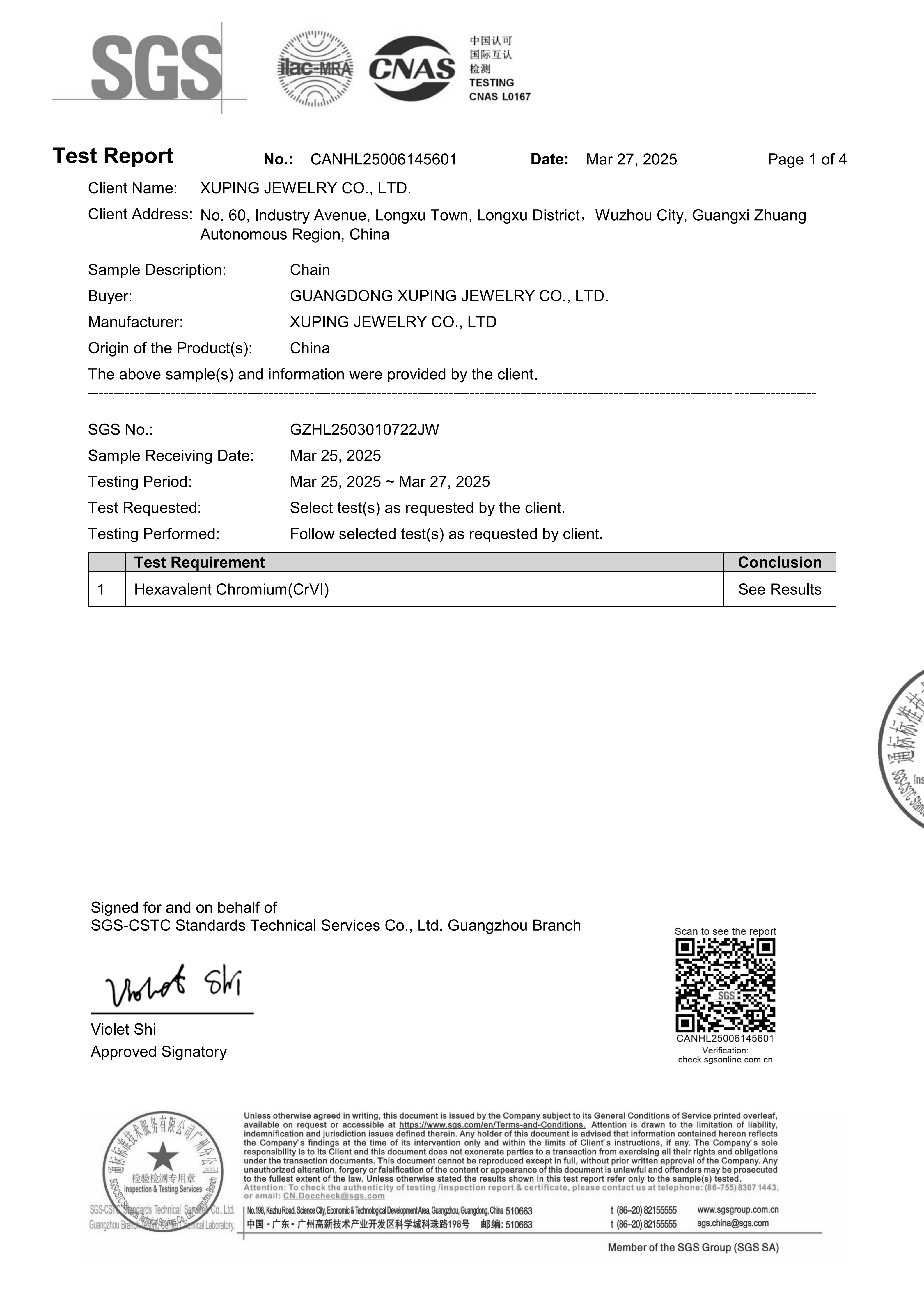
Xuping holds an ISO 9001 certificate (CACQ21Q00750R1, GB/T 19001-2016/ISO 9001:2015) with the scope “Design and production of metal jewelry”, issued 16 October 2025 and valid to 25 October 2027. Laboratory evidence includes SGS reports against REACH Regulation (EC) No 1907/2006 (CANHL25006144001, CANHL25004908001, GZHL250301072401JW) and IEC 62321-7-1:2015 (CANHL25006145601), plus a CTI report (A2230517570101001) against the IEC 62321 series. The quality-control description states 100% full inspection, an 18-stage quality check and REACH/ROHS compliance testing.
Read each document against four attributes before relying on it: holder, standard, product scope and validity dates. The reports name applicable models — for example necklaces 14N245402 and X001015911, crystal necklace X000668301, crystal earrings 14E25011845, jewelry sets X001006294 and X000871334, stainless steel necklace A00902945 and stainless steel bracelet T000959269. If your order line falls outside that list, request an applicable report or additional testing rather than citing a document that never covered the item.
For US-bound gold-plated goods, the claim itself is regulated. The FTC Jewelry Guides (16 CFR Part 23) treat misrepresentation of the presence, quantity or karat fineness of gold as deceptive, and the revised guidance retains the 10K minimum fineness and 0.175 microns (seven millionths of an inch) thresholds used in describing gold plate(d) and gold electroplate(d) products. Before listing a product as gold plated in that market, obtain a composition and plating declaration and check the wording against those criteria.
Converting Capability Evidence Into Order Terms
The final evaluation step is translation. Each verified capability should be restated as something an order can enforce, because a term that exists only in a sales conversation is not a control.
| Evaluation item | Supplier-stated position | What to fix in the order |
|---|---|---|
| Minimum order | MOQ 1 piece in the supplied purchasing terms; the official site separately displays a USD 50 minimum order value | Which minimum governs, and whether it applies per style, per colour or per shipment |
| Lead time | 30–90 days | Milestone dates: sample approval, production start, inspection, ship date |
| Delivery terms | FOB | Named port, Incoterms version, document set, freight responsibility |
| Acceptance criteria | Pre-shipment test | Test scope, sampling plan, defect classification, who signs off |
| Payment terms | PayPal, Western Union, Money Gram, Bank of China, HSBC | Method used, currency, deposit and balance split, fees |
| Customization | Engraved logos, hang tags, custom packaging | Approved artwork and dieline before bulk production |
| After-sales | 24/7 online support, quality guarantee, product replacement, OEM/ODM after-sales service, global logistics support | Replacement trigger, evidence required, response window |
Every position in the middle column is supplier-stated. Xuping's official site separately lists a USD 50 minimum order value, which answers a different question from a one-piece minimum: value versus piece count. State in the order which one governs, and confirm whether customization or mixed-colour assortments carry their own threshold.
Exception Handling: The Delivery Test After Delivery
Delivery assurance is also tested after arrival, and the quality of a supplier's exception process is evidence in its own right. Xuping's published support answers describe routes for four common failures, each with an evidence requirement:
- Short shipment or missing pieces: check the packing list against all parcels, count with photographs, and contact sales with the order number.
- Items that do not match the order: stop using or selling the goods, photograph the items, labels and packing list beside the order details, and report within 7 days with the order number.
- Delayed shipment: send the order and tracking numbers so production and logistics status can be checked and an updated schedule provided.
- Tarnish or colour change: check exposure to water, sweat, perfume or cosmetics, wipe gently and store dry and sealed; if the item arrived defective or discoloured within the policy period, report within 7 days with photographs and the order number.
Plating life depends on thickness and care, and humidity, friction and chemical contact shorten it. That matters for evaluation because it defines what your acceptance criteria must separate: a defect present on arrival, and wear that develops after weeks of normal use. Write both into the order — inspection attributes for arrival, and the reporting window plus evidence standard for after-sales claims.
Which Evidence Matters Most by Business Model
Brand OEM/ODM buyers should weight Grades 3–4 on sampling: approved sample, written specification, artwork and dieline approval for engraved logos, hang tags and custom packaging, and a stated inspection point before shipment.
E-commerce and marketplace sellers should weight MOQ flexibility, reorder consistency and packaging durability, because a colour or size variation between batches costs listings and reviews rather than a single sale.
Distributors and multi-category wholesalers should weight breadth plus certification coverage across every category stocked, since a category that cannot be documented is a category that cannot enter some markets.
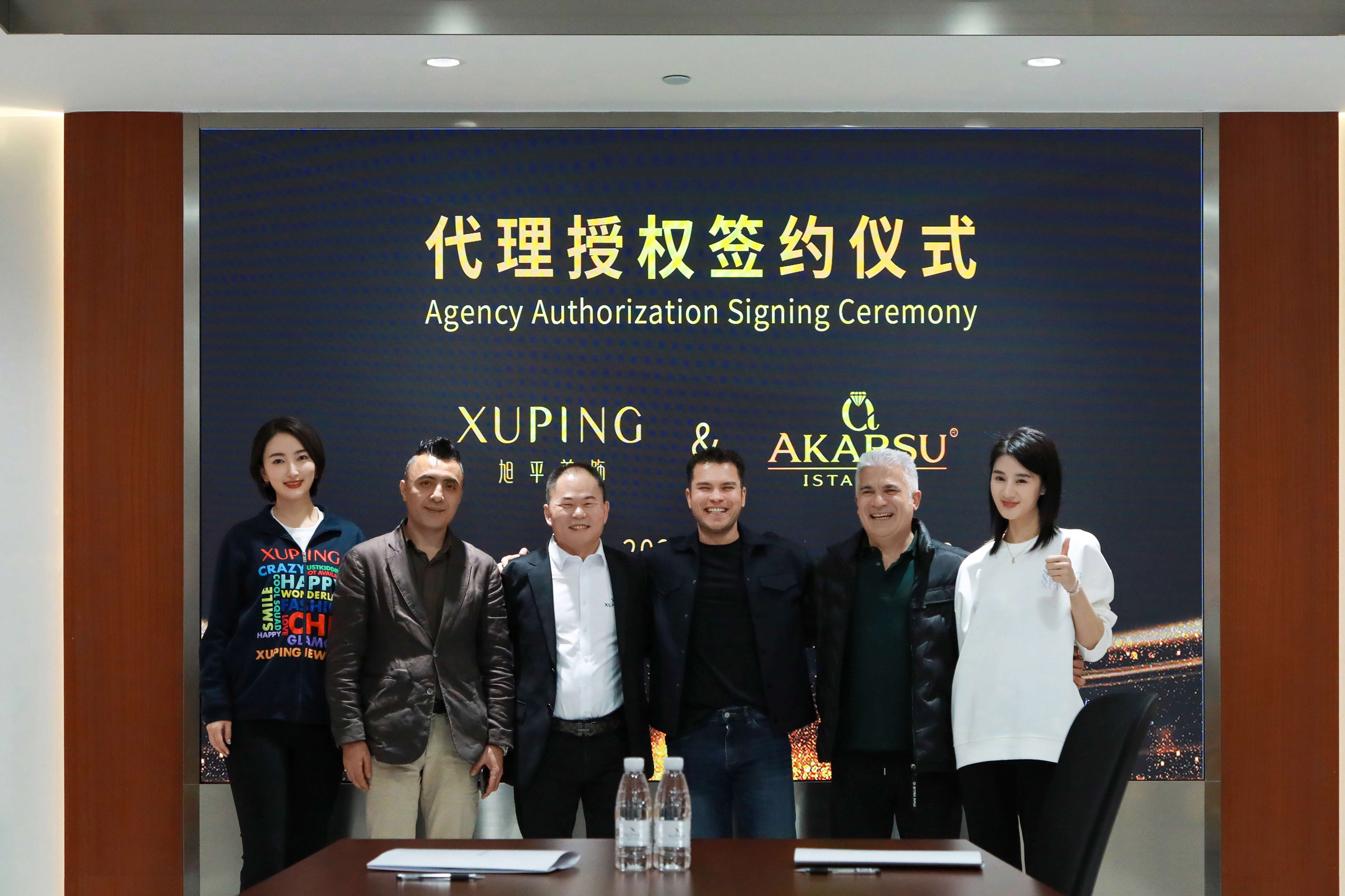
Supplier-reported case data shows the format to ask for. Xuping lists a brand authorized agent in Turkey with annual sales of over 2 million units, an application spanning retail jewelry stores, e-commerce platforms, brand OEM/ODM, wholesale distribution and promotional gifts, a duration set by the contract term, and highlights including on-time delivery and hypoallergenic materials. Use that structure to specify what a useful reference must contain — market, channel, volume, duration and delivery performance — then ask for a reference you can contact directly.
Conclusion: Evaluate the Evidence, Then Write the Order
Supplier evaluation is not a document collection exercise. Design depth such as 150 designers and 194 patents, an operating history since 1997, multi-region export coverage and a broad product range tell you what a jewelry wholesale partner is equipped to do. None of them tells you what will happen to your order. The conversion happens in three moves: grade the evidence instead of counting it, check the scope of every certificate against the exact model you are buying, and restate each verified capability as a purchasing term with a date, a tolerance and a remedy attached.
Buyers who do this stop treating capability as a proxy for delivery assurance and start treating it as the input it is. The purchase order, not the brochure, is where a supplier becomes accountable.
Frequently Asked Questions
Which documents should I request from a jewelry wholesale supplier before a first order?
Request four documents and check each for scope, not just existence. First, a quality-management certificate with number and scope — Xuping ISO 9001 is CACQ21Q00750R1, scope “Design and production of metal jewelry”, valid to 25 October 2027. Second, laboratory reports naming the standard — SGS reports against REACH Regulation (EC) No 1907/2006 and IEC 62321-7-1:2015, and a CTI report against the IEC 62321 series. Third, the list of applicable product models, so you can confirm the tested item matches your order line. Fourth, current validity dates and the certificate holder's exact legal name. Where possible, verify the document number with the issuing body.
Do 150 designers and 194 patents prove a supplier can produce my custom design?
No. Those figures evidence design capacity and iteration throughput; they do not confirm tooling, cost, minimum order quantity or lead time for your specific design. Convert them into order-level evidence: a written brief, a documented sampling route, an approved sample, and a confirmed price and schedule for that design. Xuping states OEM/ODM support for engraved logos, hang tags and custom packaging, with a 30–90 day lead time — a range that must be fixed per project before it becomes a commitment.
What is the minimum order for Xuping jewelry wholesale?
The supplied purchasing terms state a minimum order quantity of 1 piece, FOB delivery terms and pre-shipment test as the acceptance criterion. The official website separately displays a USD 50 minimum order value. Because a piece-count minimum and an order-value minimum answer different questions, confirm in writing which one governs your order, and whether engraving, custom packaging or mixed-colour assortments carry a separate threshold.
How should I evaluate a sample before committing to bulk production?
Treat the sample as Grade 3 evidence and score it against a written checklist: base metal, plating type and appearance, stone type and setting security, dimensions, weight, finish, clasp function and packaging. Record every deviation, have the corrected sample re-approved, and keep the approved sample as the physical reference for pre-shipment inspection. Agree the inspection attributes and defect definitions at the same time — a sample on its own cannot define what “acceptable” means across a production run.
Lead time is quoted as 30–90 days. How do I protect the ship date?
Convert the range into milestone dates: sample approval, production start, pre-shipment inspection and handover to freight. Ask for written confirmation of the production slot, agree a delay-notification point, and book logistics after inspection rather than before. If you are evaluating Xuping Jewelry for a first or repeat order, requesting a sample and a written quotation is the fastest way to turn the capability evidence above into terms you can check — the contact route starts at the company website.
Fashion Jewelry Materials: Plated Copper or Stainless Steel
Related Article


