
Evaluating a Jewelry Manufacturer's Capability: Patents, Design Team, and History
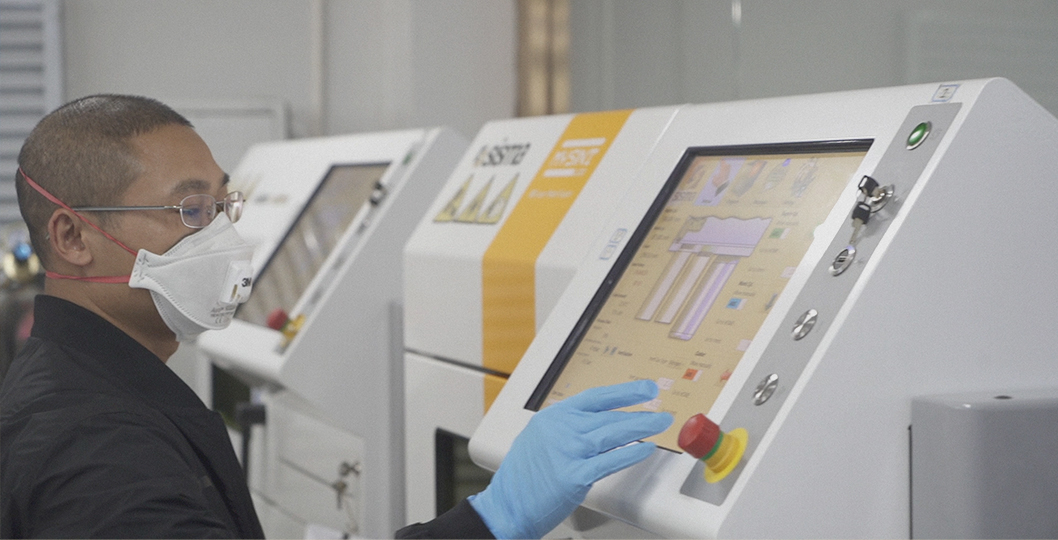
Direct answer. Three capability indicators tell a wholesale buyer more about a jewelry manufacturer than any catalog or price list: the size and relevance of its patent portfolio, whether product design is handled by an in-house team, and how many years the company has actually been manufacturing. Xuping Jewelry, the brand of Guangdong Xuping Jewelry Co., Ltd., a fashion-imitation jewelry manufacturer founded in 1997 in Guangzhou, China, reports 194 patents, a 62-person design team and nearly three decades of continuous production. Read together, those three numbers describe how fast a supplier can originate new designs and how reliably it can repeat production.
This article turns that evaluation problem into a working framework for importers, distributors, brand owners and e-commerce operators comparing wholesale jewelry suppliers: what each indicator actually measures, how to verify it, what it predicts about innovation and delivery, and where each indicator stops being useful as the buyer moves from evaluation into execution.
The Evaluation Problem: Capability Claims Are Cheap, Verifiable Capability Is Not
Wholesale jewelry is a category where almost every supplier describes itself in identical terms. Catalogs are downloadable, factory-direct claims are standard, and trend-forward product images circulate between trading companies that own no tooling at all. For a buyer building a repeatable assortment, the real risk is not picking an unattractive supplier. It is picking one whose capability cannot be re-verified after the first shipment.
That risk surfaces in four predictable ways:
- Design lag. A supplier that outsources design cannot start a new development until an external studio has capacity, which pushes seasonal ranges back.
- Sample drift. A copied design can be photographed, but tooling and finishing consistency across repeat orders is harder to guarantee.
- Compliance gaps. Documentation produced for one shipment may not be maintained as destination-market regulation changes.
- Continuity risk. Suppliers without a long operating record may exit the category or change product focus between reorders.
All four reduce to three checkable questions. Can this manufacturer originate designs? Is the design and tooling work done inside the company? Will it still be producing at the same standard three years from now? The indicators that answer those questions are patents, in-house design capacity and operating history, and those are the three examined below.
Why Capability Screening Matters More in the 2026 Jewelry Wholesale Market
Four market conditions make manufacturer capability a commercial question rather than a formality.
1. The category is large and still expanding. Analysts place the global jewelry market at roughly USD 242.79B to USD 381.5B in 2025, with projections reaching up to USD 578.5B by 2033 (Fortune Business Insights; Grand View Research). Estimates differ mainly because sources treat fine jewelry and costume jewelry differently, which is a useful reminder that any market-size figure should be read with its segment definition attached.
2. China remains a dominant wholesale sourcing base. China's total jewelry exports reached USD 11.5B in 2024, with the United States as a primary destination at USD 1.31B (Observatory of Economic Complexity). A large share of that volume moves through wholesale and OEM channels, so supplier capability screening has a direct effect on the quality of the assortment that reaches the shelf.
3. Online channels are changing reorder behaviour. Online jewelry retail is projected to grow at roughly 8.0% to 13% CAGR and to represent 25-30% of total industry purchases by 2026 (Grand View Research; Statista). Online sellers reorder in smaller, faster cycles and depend on the supplier's design pipeline to keep listings fresh, which is precisely what a design team and a patent portfolio measure.
4. Compliance pressure is constant. Jewelry sold in the EU must meet REACH Regulation (EC) No 1907/2006, including nickel release limits of 0.5 μg/cm²/week, lead at 500 mg/kg and cadmium at 100 mg/kg (European Chemicals Agency). Jewelry intended for children under 14 is classified as a toy in the EU and requires CE marking under the Toy Safety Directive 2009/48/EC. A manufacturer that maintains its certification file can support these requirements; one that does not transfers the risk back to the buyer.
The Three Capability Indicators and What They Predict
A capability indicator is only useful if it can be verified, compared and connected to an outcome the buyer cares about. The three below meet all three conditions.
Indicator 1 - Patent Portfolio: Evidence That Designs Are Originated, Not Reproduced
Xuping Jewelry holds 194 patents. A portfolio of that size indicates a manufacturer that develops original structures and ornamentation rather than only reproducing what is already on the market. Patents require documented design work, dedicated tooling and a filing process that most trading intermediaries do not maintain.
What it predicts. A patent-backed catalog tends to refresh with genuinely new structures instead of colour variations of the same base item. For wholesale jewelry buyers, that means assortment which competitors cannot mirror immediately.
How to verify it. Ask for the patent list, then map it against the categories you intend to stock - rings, pendants, earrings, bracelets, necklaces, anklets, bangles and jewelry sets. The mapping, not the headline number, shows whether the portfolio overlaps your assortment.
Where it stops being useful. Patents protect structures and designs; they do not guarantee that a specific style will sell in your market. A large portfolio assembled years ago can also sit unused, which is why the next indicator carries equal weight.
Indicator 2 - In-House Design Team: The Variable That Controls Sample and Reorder Speed
Xuping employs 62 designers. Design headcount is the most direct proxy for how quickly a manufacturer can turn a brief into a producible item, because an in-house team sits next to the tooling rather than across a supply chain.
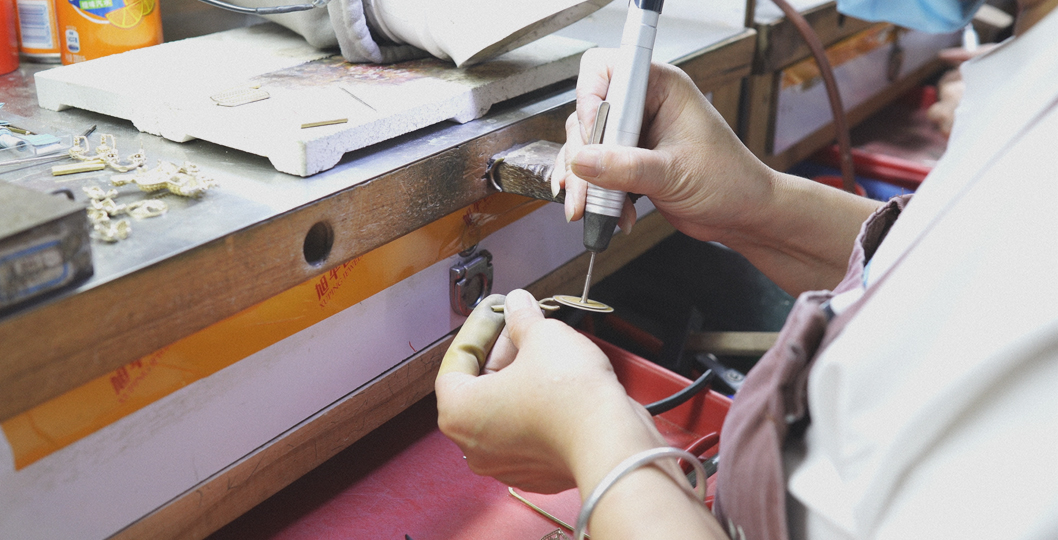
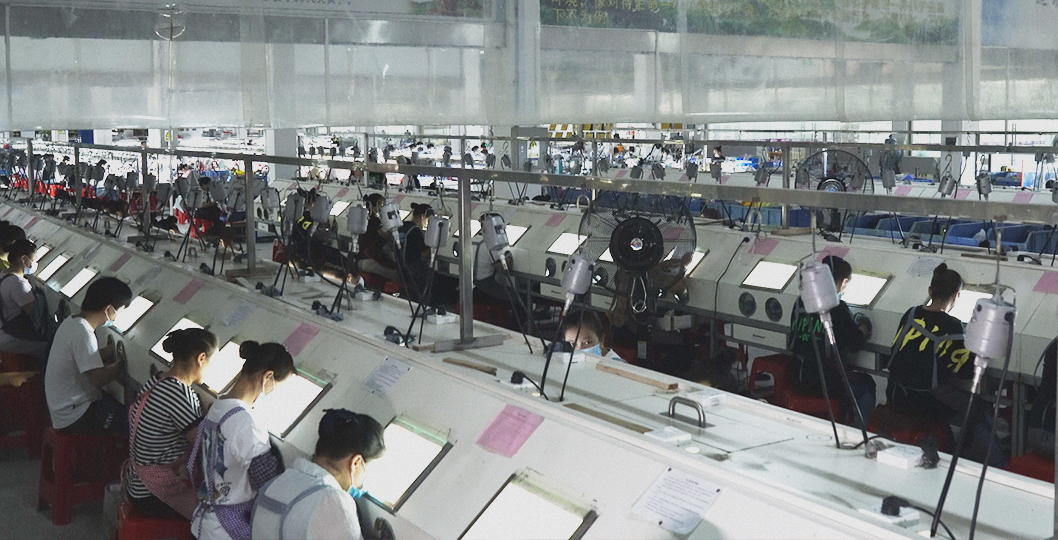
The capability is visible in the production workflow itself, which includes stages such as 3D drafting, 3D printing, pattern making, hand carving, wax injection, wax tree mounting, findings work, soldering, engine turning and chain making. These are not marketing steps. They are the sequence that turns a drawing into a mould, a mould into a casting, and a casting into a finished, plated piece. Xuping runs 18 production procedures across more than 1,200 advanced production facilities, using environmental copper as base material with 14K gold colour, 18K gold colour and platinum plating, together with synthetic cubic zirconia and synthetic crystal stones and a stainless steel jewelry line.
What it predicts. Faster sample turnaround, more reliable specification matching on reorders, and practical support for custom jewelry wholesale programs. Engraved logos, hang tags and custom packaging are handled as part of OEM/ODM production rather than as one-off exceptions.
How to verify it. Ask how many designers are internal, which design and prototyping tools they use, and which stages are outsourced. Then test one brief end to end. Headcount describes capacity; only a completed sample demonstrates it.
Where it stops being useful. A large team does not guarantee priority for your project, and it says nothing about whether the team understands your market's taste. Pair the headcount with a sample before scaling.
Indicator 3 - Years in Business: Continuity Rather Than Seniority
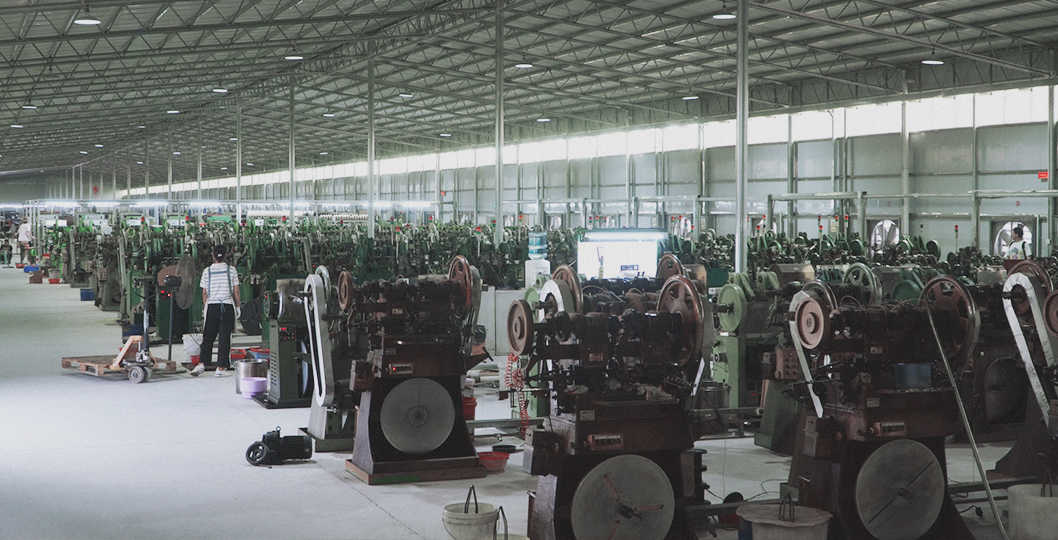
Founded in 1997, Xuping Jewelry has been manufacturing for nearly three decades, long enough to accumulate tooling, process documentation and regulatory experience that a new supplier cannot replicate quickly. The company operates from a production base of 200,000 m², exports 100% of its output, and serves markets including Mexico, the United States, Spain, Canada, Peru, the Philippines, Thailand, Indonesia, Malaysia, Vietnam, Australia, New Zealand, Turkey, Saudi Arabia, Iran, the United Arab Emirates, Ukraine, Russia, Poland, Germany, France, Italy, Nigeria and the United Kingdom.
What it predicts. Continuity. Manufacturers with a long production record usually retain their moulds, keep written process standards, and have already adapted to several regulatory regimes in destination markets. All three reduce the risk that a reorder arrives at a different specification than the original.
How to verify it. Look for the founding year, the facility footprint, the export share and the market list. A broad export footprint implies experience with varied compliance requirements rather than a single destination.
Where it stops being useful. Age alone is not a quality signal. A long-established manufacturer that has stopped refreshing designs is a weaker partner than a younger one with active development. Read history together with patents and design capacity, never in isolation.
Supporting Indicators: Capacity, Quality Control and Compliance Documentation
Capability converts into delivery only when capacity and control systems are in place. Xuping's figures are a monthly output capacity of 8,000,000 pieces and an annual output of more than 100,000,000 pieces, supported by 100% full inspection, an 18-stage quality check, SGS-certified quality control and REACH/ROHS compliance testing.
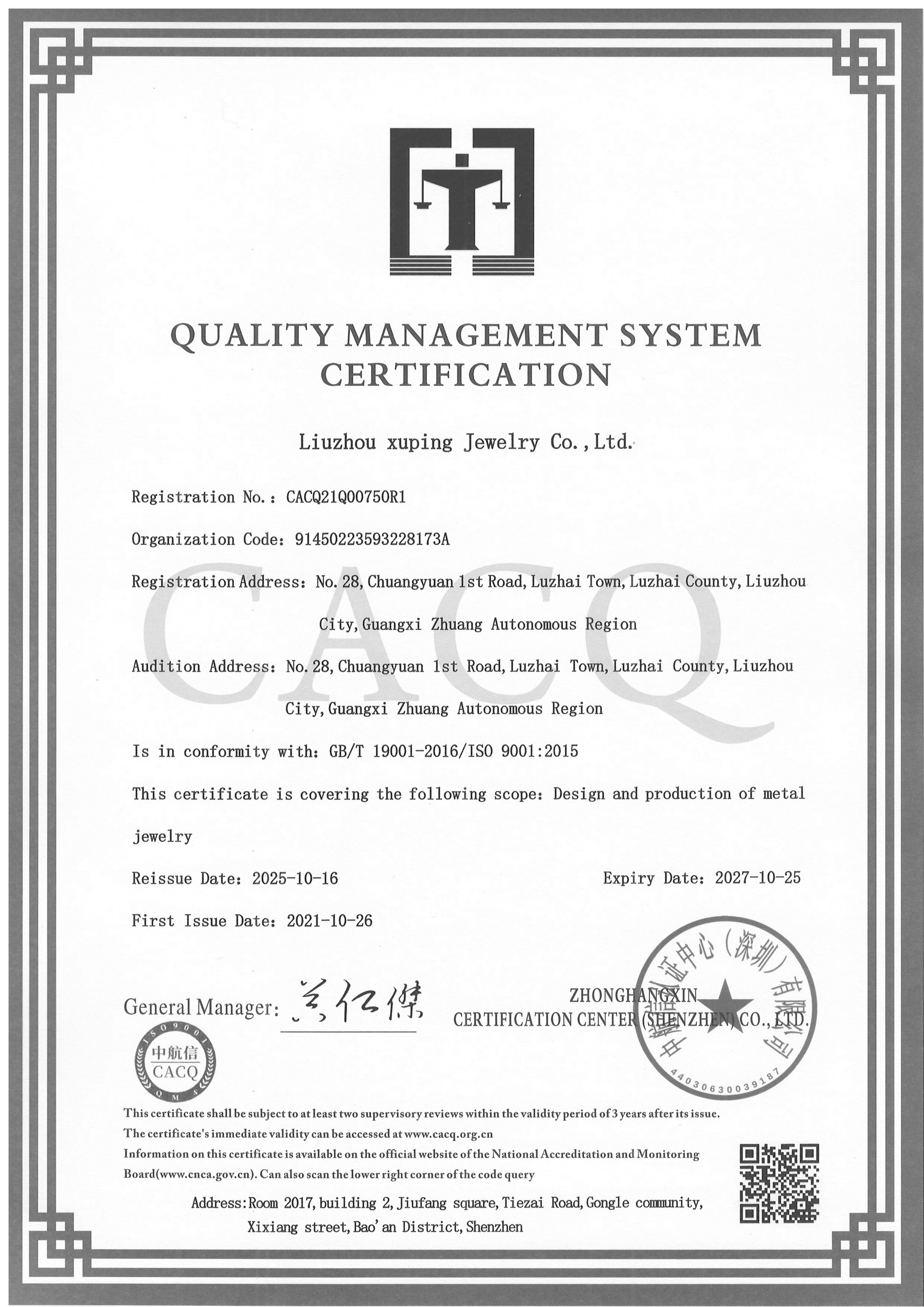
Documentation includes ISO 9001:2015 certification (GB/T 19001-2016/ISO 9001:2015), certificate number CACQ21Q00750R1, issued 16 October 2025 and valid until 25 October 2027 by ZHONGHANGXIN CERTIFICATION CENTER (SHENZHEN) CO., LTD., covering the design and production of metal jewelry. SGS documents include certificates CANHL25006144001 and GZHL250301072401JW against REACH Regulation (EC) No 1907/2006 (valid to March 2030), CANHL25006145601 against IEC 62321-7-1:2015, and CANHL25004908001, alongside CTI certificate A2230517570101001 valid to October 2028.
Commercial and execution terms matter equally at this stage: a minimum order quantity starting at 1 piece, lead time of 30-90 days, FOB delivery terms, pre-shipment test as the acceptance criterion, payment through PayPal, Western Union, Money Gram, Bank of China or HSBC, and after-sales coverage that includes 24/7 online support, an after-sales quality guarantee, product replacement, OEM/ODM after-sales service and global logistics support.
A Six-Step Framework for Evaluating Wholesale Jewelry Suppliers
The sequence below follows the order a buyer actually moves through: design evidence first, then compliance, then capacity, then validation, then commercial terms.
- Request design-side evidence. Ask for the patent list, the number of internal designers and the production stages the factory performs itself. Compare the answers against the catalog you were shown.
- Map design assets to your tiers. Confirm which categories and materials the design capacity actually covers, for example copper-based pieces with gold-colour plating, stainless steel lines, and cubic zirconia or synthetic crystal stone settings, then match them to your price architecture.
- Verify compliance against your destination market. Check certificate numbers, issuing bodies, standards and both issue and expiry dates. REACH documentation is essential for EU-bound jewelry; CE documentation is required if any item is classified as a toy for children under 14.
- Test the capacity math. Compare your projected annual volume and reorder frequency against the supplier's monthly capacity and 30-90 day lead time. A manufacturer producing 8,000,000 pieces per month can absorb seasonal peaks that a small workshop cannot.
- Validate with a sample-scale order. Because the minimum order quantity starts at 1 piece and acceptance is based on a pre-shipment test, buyers can verify finish, weight, plating colour and stone setting before committing to bulk. Item-level parameters are published, so a sample can be measured against its stated dimensions and weight.
- Confirm execution terms in writing. Delivery terms, payment methods, acceptance criteria and the after-sales replacement policy should all be documented before the first production run.
How the Indicators Look in Real Wholesale Programs
Capability indicators earn their place when they appear in programs that keep running. Xuping's brand authorized agent cases show what sustained wholesale volume looks like across markets with different compliance regimes and consumer preferences.
- Turkey. A brand authorized agent project with annual sales of over 2 million units, covering retail jewelry stores, e-commerce platforms, brand OEM/ODM, wholesale distribution and promotional gifts.
- Morocco. A brand authorized agent project with annual sales of over 3 million units across the same channel mix.
- Indonesia. A brand authorized agent project with annual sales of over 2 million units.
- Turkmenistan. A brand authorized agent project implemented in Turkmenistan and completed according to the contract term.
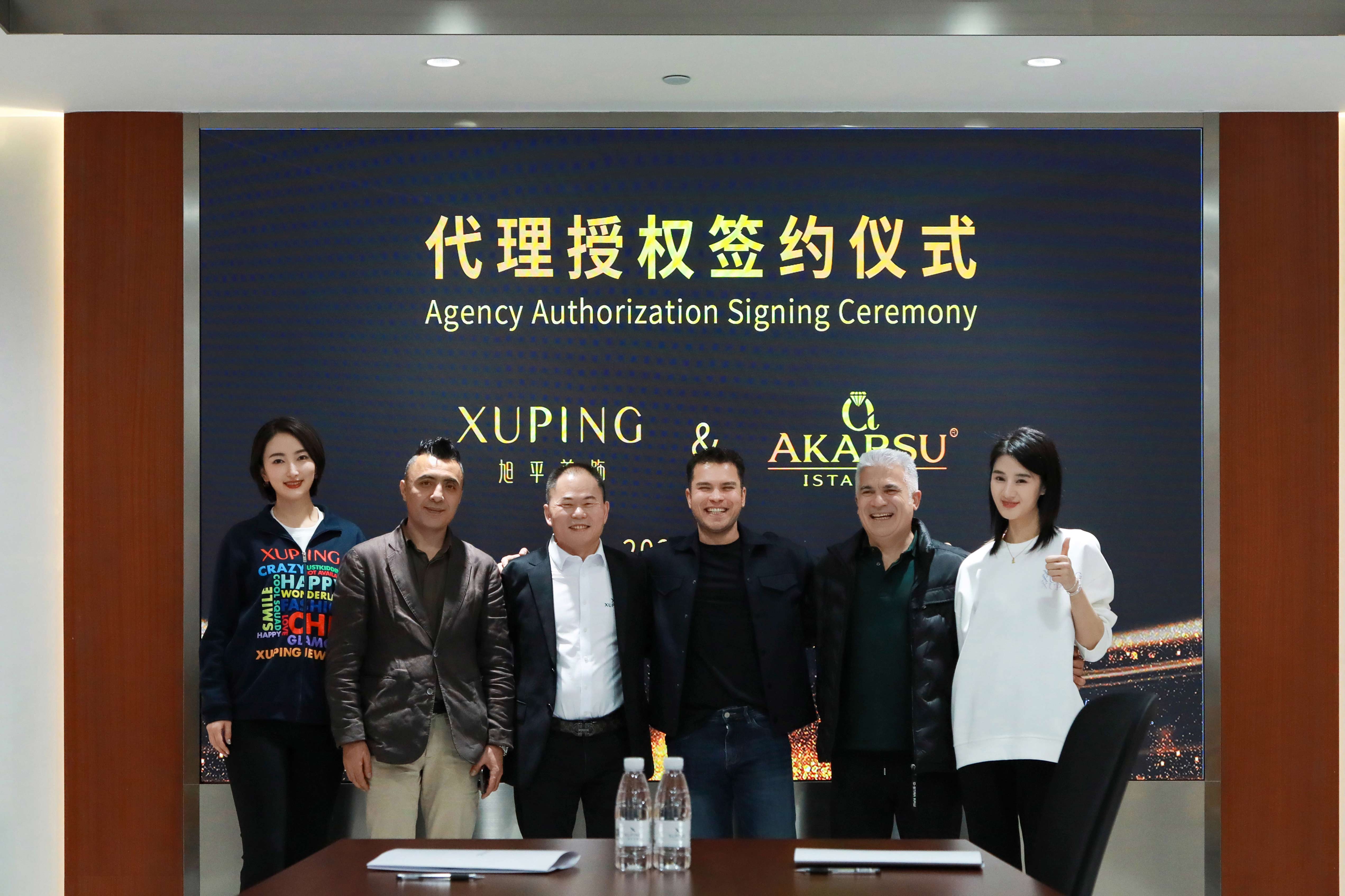
The recurring factors behind these programs are consistent: a wide and frequently updated style range, hypoallergenic materials, and on-time delivery. Those are outputs of the same three indicators - a design pipeline that keeps generating new styles, a factory that can produce them to a repeatable standard, and a business with enough operating history to build the documentation and logistics behind them.
Capability Indicator Comparison Table
| Indicator | What it predicts | How to verify it | Xuping's verified position | Risk if the indicator is weak |
|---|---|---|---|---|
| Patent portfolio | Original design development rather than reproduction | Request the patent list and map it to your categories | 194 patents | Assortment becomes easy for competitors to copy |
| In-house design team | Sample speed and specification matching on reorders | Ask for internal designer headcount and performed process stages | 62 designers; 3D drafting, 3D printing, pattern making, hand carving, wax injection, soldering, engine turning and chain making among 18 production procedures | Design queues and delayed seasonal ranges |
| Years in business | Continuity of tooling, process standards and compliance experience | Check founding year, facility size, export share and market list | Founded 1997; 200,000 m² production base; 100% export ratio; markets across Europe, the Americas, the Middle East, Asia and Africa | Specification drift or supplier exit between reorders |
| Production capacity | Ability to absorb seasonal peaks and large reorders | Compare monthly capacity with your forecast volume | 8,000,000 pieces monthly; more than 100,000,000 pieces annually; more than 1,200 production facilities | Stock-out risk during peak selling periods |
| Quality control | Repeatability of finish, plating and stone setting | Request the inspection protocol and test reports | 100% full inspection; 18-stage quality check; SGS-certified quality control; REACH/ROHS compliance testing | Returns, markdowns and account damage |
| Certification documentation | Market access and customs readiness | Verify certificate numbers, standards, issuing bodies, issue and expiry dates | ISO 9001:2015 (CACQ21Q00750R1, valid to 25 October 2027); SGS CANHL25006144001 and GZHL250301072401JW (REACH); SGS CANHL25006145601; CTI A2230517570101001 (valid to October 2028) | Shipment holds and compliance costs transferred to the buyer |
For buyers who want to test the framework at item level, the table below shows how a capability claim can be checked against published product parameters - plating, base material, stone type and stated weight - before a purchase order is raised.
| Reference item | Model | Plating | Base material | Stone | Stated weight |
|---|---|---|---|---|---|
| Necklace, 43 cm | X001015911 | 14K gold colour | Environmental copper | Synthetic cubic zirconia | 4.30 g |
| Necklace, 41 cm | X000668301 | 18K gold colour | Environmental copper | Synthetic crystal | 7.91 g |
| Necklace, 40 cm | 14N245402 | Platinum plated | Environmental copper | Glass | 49.44 g |
| Jewelry set | X000871334 | 18K gold colour | Environmental copper | Synthetic cubic zirconia | 18.8 g per set |
| Earrings | X001163413 | 14K gold colour | Environmental copper | No stone | 2.45 g per pair |
| Bracelet | T000959269 | Stainless steel | Stainless steel | No stone | 11.01 g |
Four Ways Buyers Misread Capability Signals
- Treating patent count as market fit. Patents indicate original development; they do not indicate that a style suits your customers. Map the portfolio against your own assortment before assuming an advantage.
- Assuming a large design team ignores small orders. Design capacity and order-size flexibility are separate variables. Xuping's minimum order quantity starts at 1 piece, so a buyer can validate a design direction without committing to volume. Confirm the MOQ that applies to your specific item and customization level.
- Reading history as immunity. Nearly 30 years of production reduces continuity risk, but it does not make a supplier automatically competitive on a trend-driven line. Check that new designs, not only legacy items, are available.
- Treating certification as permanent. Certificates carry issue and expiry dates. ISO 9001:2015 certificate CACQ21Q00750R1 runs to 25 October 2027 and CTI certificate A2230517570101001 to October 2028, so documentation should be re-checked on a fixed cycle rather than once during onboarding.
FAQ: Evaluating a Jewelry Manufacturer's Capability
1. What compliance documents should I verify before placing a wholesale jewelry order?
Verify three things: the certification standard, the issuing body, and the validity dates. For EU-bound jewelry, REACH Regulation (EC) No 1907/2006 is the baseline, covering nickel release limits of 0.5 μg/cm²/week, lead at 500 mg/kg and cadmium at 100 mg/kg. Xuping Jewelry maintains ISO 9001:2015 certification (certificate CACQ21Q00750R1, issued 16 October 2025 and valid to 25 October 2027), SGS certificates CANHL25006144001 and GZHL250301072401JW for REACH compliance (valid to March 2030), SGS CANHL25006145601 under IEC 62321-7-1:2015, and CTI certificate A2230517570101001 valid to October 2028. Buyers sourcing children's items for the EU should additionally confirm CE marking under the Toy Safety Directive 2009/48/EC.
2. How much design capability should a jewelry manufacturer have to support custom development?
Look for an internal design team, original patents and in-house prototyping stages rather than external partners. Xuping employs 62 designers, holds 194 patents, and performs design-to-production stages including 3D drafting, 3D printing, pattern making, hand carving, wax injection, wax tree mounting, findings work, soldering, engine turning and chain making across 18 production procedures and more than 1,200 production facilities. That structure supports custom jewelry wholesale and OEM/ODM work such as engraved logos, hang tags and custom packaging. Capacity figures describe the ceiling; a completed sample is the proof.
3. How do I keep the cost of a wholesale jewelry program predictable?
Cost predictability comes from specification control rather than headline unit price. Compare quotations at identical specification levels - plating type, base material, stone type and item weight - and confirm commercial terms in writing. Xuping's terms are a minimum order quantity starting at 1 piece, FOB delivery terms, pre-shipment test as the acceptance criterion, and payment through PayPal, Western Union, Money Gram, Bank of China or HSBC. Validating a sample-scale order before bulk production is the cheapest way to avoid a mismatch that later becomes a markdown.
4. Can I validate design and quality before committing to bulk orders?
Yes. A minimum order quantity starting at 1 piece allows sample-scale validation, and acceptance is based on a pre-shipment test, so finish, plating colour, stone setting, dimensions and weight can be checked against stated parameters before volume production. Xuping supports product replacement and an after-sales quality guarantee, provides 24/7 online support, and offers OEM/ODM after-sales service for customized programs.
5. What lead time should I expect from a manufacturer producing at this scale, and how do I start?
Xuping quotes a lead time of 30-90 days depending on item and customization level, supported by monthly capacity of 8,000,000 pieces and global logistics support. To start an evaluation, request a sample or quotation with your target categories and specifications - Xuping Jewelry can be reached at wlwf@xuping.com.cn, by phone or WhatsApp at +86 139-2505-0911, or through www.xupingjewelry.com.
Conclusion: Convert Capability Indicators Into Delivery Expectations
Screening wholesale jewelry manufacturers becomes simpler once the questions are measurable. A patent portfolio asks whether a supplier originates designs. A design team asks whether that work happens inside the company. Operating history asks whether the supplier will still be producing to the same standard at your next reorder. Xuping Jewelry's verified figures - 194 patents, 62 designers, manufacturing since 1997, 8,000,000 pieces monthly capacity, ISO 9001:2015 and SGS/CTI documentation, a minimum order quantity from 1 piece and 30-90 day lead times - are presented here as a worked example of the framework, not as a replacement for your own verification.
Apply the six steps, re-check the certificates on a fixed cycle, and validate with a sample before scaling. That is the process that turns a supplier presentation into a supply decision.
Next Step: Request a Capability Pack and Sample
Buyers evaluating Xuping Jewelry can request the patent and certification pack, a category catalog with item-level parameters, or a sample-scale order to test design and finishing before committing to bulk.
Email: wlwf@xuping.com.cn | Tel / WhatsApp: +86 139-2505-0911 | Website: www.xupingjewelry.com
Address: 4th Floor, No. 28, Zhanqian Street, Zhanqian Road, Liwan District, Guangzhou, China
In mixed-material jewelry, the smallest metal components may be the most important
Related Article


