
Jewelry Wholesale Technical Guide Stainless Steel Copper Plating Specs
When two jewelry wholesale quotes look identical on a catalog page, the difference usually sits in fields that are easy to skip: base metal, plating description, stone type and size, length plus extension, unit weight, and the acceptance documents behind the order. Those six fields decide how a SKU behaves in a retail case long after the photo stops mattering.
Short answer: A wholesale buyer should compare six spec fields before committing to an order — base metal, plating description, stone type and main-stone size, length with extension and stated tolerance, unit weight per piece or pair or set, and written acceptance evidence such as SGS, ISO and REACH documents. Each field has to be recorded in writing on the purchase order, not inferred from the product image.

Production base of Guangdong Xuping Jewelry Co., Ltd., Guangzhou, China — the reference point for the catalog specifications discussed in this guide.
Problem Definition: Why Wholesale Jewelry Spec Sheets Get Misread
The failure mode is rarely a missing spec. It is a spec that carries two meanings.
- Color names are not metal content. A line reading “14K gold color” on a plating field describes the finish applied to the piece. A line reading “14K gold plating” would be a different commercial claim. Confusing the two is a procurement risk, not a typing error.
- Chain length is not wearing length. A stainless steel necklace listed at 400 mm with a 60 mm extension covers a different range on the neck than a 400 mm chain with no extension.
- Unit weight is not always per piece. Earrings are weighed per pair, sets are weighed per set, and bracelets per piece. A 28.43 g “set” and a 28.43 g “necklace” are not comparable numbers.
- Tolerance symbols travel. A note such as ±2 cm may apply to the bracelet, the necklace, or the whole set depending on where it is placed in the spec block.
- Base-metal labels are categories, not chemistry. “Environmental Copper” identifies a material family. It does not state alloy ratio or plating thickness.
For an Evaluation-stage buyer, these ambiguities surface at the worst moment — after the sample is approved and before the reorder is placed. Reading the spec block line by line, and forcing each line into a confirmable value, removes most of that risk.
Industry Background: Why Specification Precision Became a Differentiator
The category is large enough that catalog images no longer separate suppliers. TrendX Insights estimates the global fashion jewelry market at USD 42.62 billion in 2025, growing to USD 74.49 billion by 2034. Within that total, the same source places the stainless steel jewelry segment at USD 2.603 billion in 2025 — a sub-segment large enough to deserve its own spec vocabulary.
Supply is equally concentrated. World Bank WITS data drawn from UN Comtrade records China’s 2023 export value for imitation jewelry under HS code 711790 at USD 935.97 million. Chinese manufacturers therefore ship against a very wide range of destination requirements, and a single factory may hold both stainless steel and environmental copper lines, each with its own plating and stone conventions.
Regulation has caught up to that variety. The U.S. Federal Trade Commission’s Jewelry Guides (16 CFR Part 23) treat a misrepresentation of the presence, quantity or karat fineness of gold in a jewelry product as unfair or deceptive. The revised guidance retains the earlier reference thresholds for describing products as gold plated or gold electroplated: a 10K minimum fineness and a 0.175 micron coating thickness. For wholesale buyers, that turns plating wording from a marketing detail into a compliance line item.
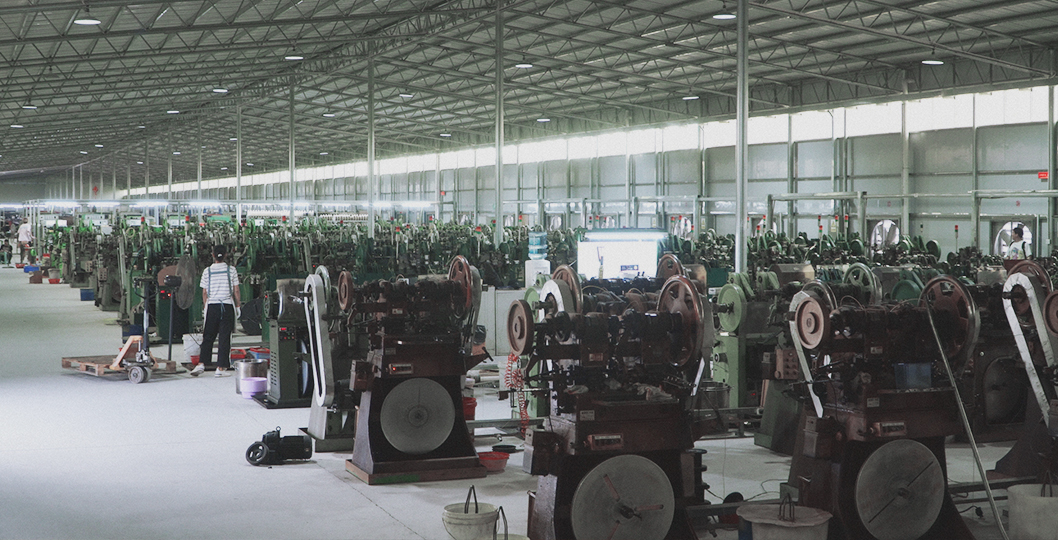
Chain workshop: link geometry, wire diameter and closure type are fixed at this stage, long before the plating line is reached.
Six Specifications Ranked by Decision Weight
Not every field on a spec block carries the same weight. For a wholesale buyer at the evaluation stage, the practical ranking runs as follows.
- Base metal. Stainless steel and environmental copper behave differently in weight, forming and plating durability. This field drives cost and position at the same time.
- Plating description and method. Platinum plated, 14K gold color and 18K gold color are the three finishes used across the catalog examples in this guide. The finish determines color consistency across a reorder.
- Stone type and main-stone size. Synthetic cubic zirconia, synthetic crystal and glass are visually similar in a photo and different in spec. Main-stone dimensions decide perceived value at retail.
- Length, extension and tolerance. These three values together define fit. A missing tolerance is a missing acceptance criterion.
- Unit weight. Weight per piece, per pair or per set is the fastest proxy for construction decisions such as wire thickness and stone setting density.
- Acceptance evidence. Certificates and inspection records are ranked last not because they matter least, but because they only become decisive once the first five fields are settled.
Detailed Solution: How to Convert Each Field into a Checkable Value
Base metal: stainless steel versus environmental copper
Stainless steel is a dense, structure-forward base metal. Stainless steel necklace A00902945 measures 400 × 1 mm and weighs about 6.30 g for a one-millimeter wire — a weight-to-length ratio that reflects the base metal, not a plating layer. Stainless steel bracelet T000959269 measures about 170 × 6 mm with a 30 mm extension and weighs about 11.01 g, again consistent with a dense 6 mm band.
Environmental copper sits under the plating in a different structural role. Necklace 14N245402 reaches 440 × 6 mm at 49.44 g in environmental copper with platinum plating and a dark blue glass main stone. That combination of width and weight is achievable because the copper alloy is formable across the full length of the piece, with the plating supplying the surface finish.

Soldering station: every joint and closure on a plated piece is a potential plating throw-off point, which is why joint count belongs in the acceptance discussion.
Plating: platinum plated, 14K gold color, 18K gold color
The catalog uses three plating descriptors. Platinum plating appears on 14N245402, anklet X000988693 and brooch A00900238. 14K gold color appears on A00902945, necklace X001015911, set X001006294, bracelet X000977345, earrings X001163413, ring X001114331, bangle X000867735 and brooch X000852427. 18K gold color appears on set X000871334, necklace X000668301, earrings 14E25011845, bracelet X000992979, pendant X001122748, bangle X000998659 and earrings X000881925.
The wording distinction matters commercially. A buyer should ask the supplier to state the plating description exactly as it will appear on the invoice and on any retail-facing copy. Where a U.S. sale is planned, the FTC guidance thresholds described earlier should be checked against the intended claim rather than against the color name alone.
Stones: synthetic cubic zirconia, synthetic crystal and glass
Stone fields in this catalog are written in a consistent format: color, stone type, main-stone size. Pendant X001122748 uses a white synthetic cubic zirconia main stone at 2 × 2 mm in an 18K gold color finish. Set X000871334 uses white synthetic cubic zirconia at 2.5 × 2.5 mm across a necklace, bracelet and earring. Necklace X000668301 uses a lilac synthetic crystal main stone at 18 × 17 mm — a materially larger stone, which is why the whole piece is 7.91 g at only 410 × 1 mm. Earrings 14E25011845 pair an AB color synthetic crystal with a 27 × 14 mm earring at 8.88 g per pair. Necklace 14N245402 uses dark blue glass as the main stone.
The lesson for wholesale buyers is that “Cz” is a family label. A 2 × 2 mm cubic zirconia and an 18 × 17 mm synthetic crystal produce entirely different perceived value, and the spec line should always carry the dimension.
Length, width, extension and tolerance
Four numbers define fit, and they are frequently collapsed into one in casual conversation. Stainless steel necklace A00902945 is specified as 400 × 1 mm with a +60 mm extension — a 400 mm base chain with 60 mm of adjustment. Anklet X001124310 is specified as 280 × 5 mm with +30 mm. Set X000871334 carries a different convention: bracelet 200 × 3 mm, necklace 450 × 3 mm, both with a stated ±2 cm tolerance, while the pendant and earring dimensions are quoted separately.
A buyer comparing two suppliers should require the same convention on both quotes. Where a tolerance appears, it should be tied to a named component rather than to the whole set.
Unit weight as a proxy for construction
Weight is the cheapest available signal for how a piece is built. Ring X000877263 carries no stone at 2.56 g, while ring X001114331 carries a 3 × 2 mm white synthetic cubic zirconia at 5.65 g — the difference reflects setting work as well as metal. Earrings X001163413 sit at 2.45 g per pair with no stone; earrings X000881925 carry a 2 × 2 mm cubic zirconia at 5.37 g per pair. Neither number is “better.” They tell a buyer how the two pairs will feel and how they should be priced.
Acceptance criteria: the documents that make a spec enforceable
Specifications only hold if a test result sits behind them. Xuping Jewelry holds SGS test reports issued under REACH Regulation (EC) No 1907/2006, including report CANHL25006144001, issued 2025-03-27 and valid to 2030-03-27, and report GZHL250301072401JW covering necklaces, issued 2025-03-31. A separate SGS report, CANHL25006145601, references IEC 62321-7-1:2015. CTI certificate A2230517570101001 references IEC 62321-5:2013, IEC 62321-4:2013+AMD1:2017, IEC 62321-7-2:2017, IEC 62321-6:2015 and IEC 62321-8:2017, issued 2023-10-13 and valid to 2028-10-13. ISO 9001 certificate CACQ21Q00750R1 covers “Design and production of metal jewelry” under GB/T 19001-2016/ISO 9001:2015, issued 2025-10-16 and valid to 2027-10-25.
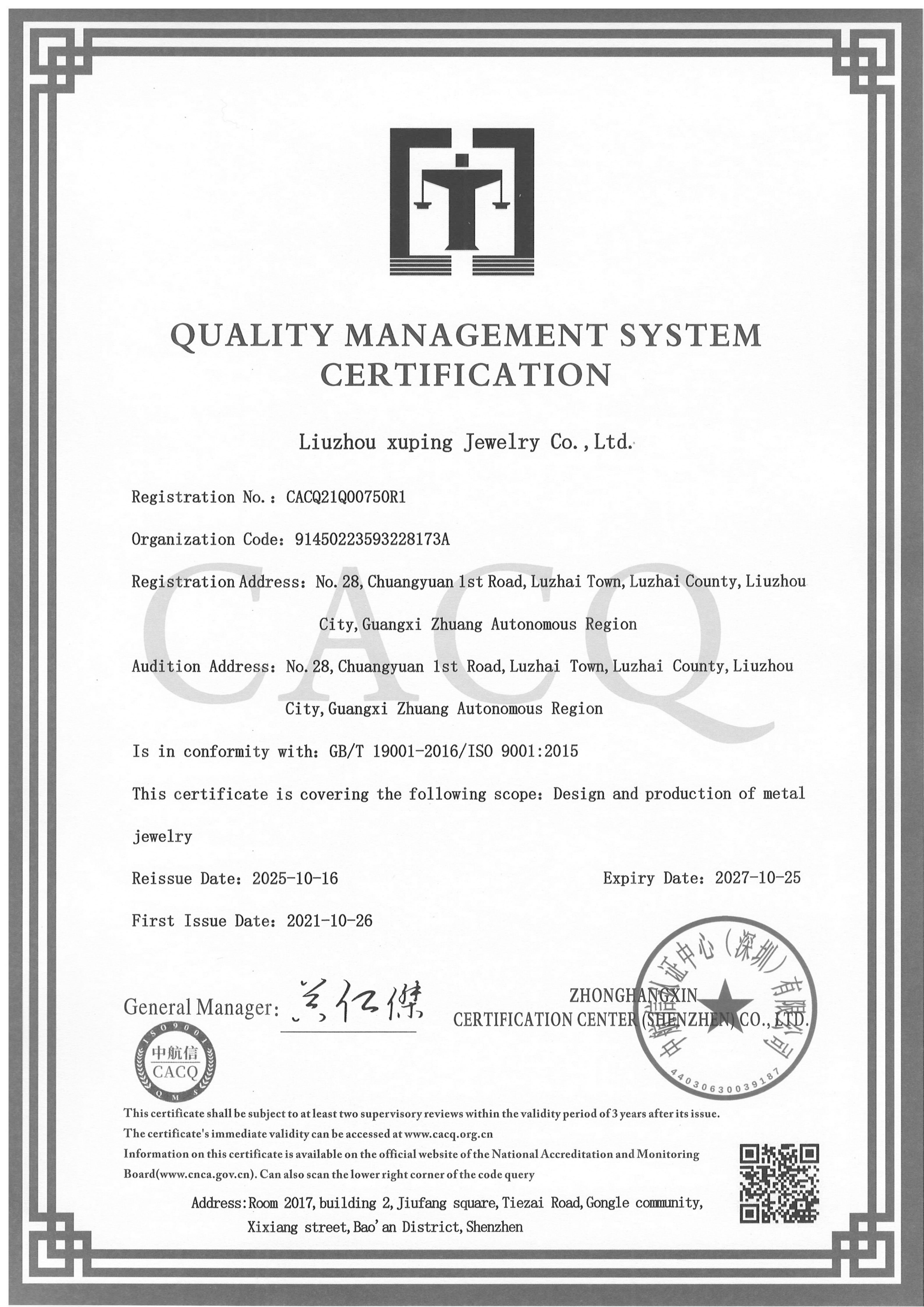
ISO 9001 certificate CACQ21Q00750R1, scope: design and production of metal jewelry, valid to 2027-10-25.
Step-by-Step Breakdown: Reading Three Catalog SKUs as Test Cases
Step 1 — Stainless steel necklace A00902945
Read the line in order: material (stainless steel), plating method (14K gold color), length field (40 cm), dimensional field (400 × 1 mm, +60 mm), stone field (no stone), unit weight (about 6.30 g). That produces a testable description — a one-millimeter stainless steel chain finished in 14K gold color, adjustable from 400 mm to 460 mm, weighing about 6.30 g per piece. A buyer can verify every one of those values with calipers and a scale on a sample.
Step 2 — Stainless steel bracelet T000959269
The same sequence applied to a bracelet produces a different construction profile: about 170 × 6 mm with a 30 mm extension, weighing about 11.01 g. The width-to-weight relationship here is the point. A 6 mm band at that weight gives a buyer a concrete indication of wall thickness and how the bracelet will sit — information a product photo cannot deliver.
Step 3 — Environmental copper set X001006294
Sets are where unit confusion costs the most. X001006294 is listed as 14K gold color, environmental copper, white synthetic cubic zirconia main stone at 2 × 2 mm, with earring size 18 × 10 mm, pendant size 26 × 12 mm, bangle size 60 × 13 mm at ±2 cm, and a unit weight of 28.43 g per set. The buyer now knows exactly what the tolerance applies to and exactly what the weight refers to. Comparing that to set X000871334 — 18K gold color, white synthetic cubic zirconia at 2.5 × 2.5 mm, bracelet 200 × 3 mm, necklace 450 × 3 mm, 18.8 g per set — gives two coherent, non-comparable-to-each-other profiles rather than two ambiguous ones.
Working rule: if any one of the six fields is missing or ambiguous on a quote, the SKU is not yet ready for a purchase order. Ask for the missing value in writing rather than resolving it from the image.
Use Cases: Which Specification Combination Fits Which Buyer
Minimalist and daily-wear assortments. Stainless steel in a 14K gold color finish suits this position. A00902945 and T000959269 both sit in the catalog's Daily series, and both carry no stone — a combination that keeps the visual language restrained and the reorder logic simple.
Statement and luxury-position assortments. Wide environmental copper pieces with larger stones carry this position. Necklace 14N245402 at 440 × 6 mm and 49.44 g with a dark blue glass main stone, and necklace X000668301 with an 18 × 17 mm lilac synthetic crystal at 7.91 g, are both listed in the Luxury or Simple series groupings and serve different ends of the same range.
Gift and set-based retail. Sets remove the need for a buyer to assemble a matching look. X001006294 delivers earring, pendant and bangle in one set at 28.43 g; X000871334 delivers earring, bracelet and necklace at 18.8 g. Both are specified as complete units, which simplifies shelf merchandising and price-point construction.
Event and occasion accessories. Crystal-forward pieces sit here. Earrings 14E25011845 at 27 × 14 mm and 8.88 g per pair with an AB color synthetic crystal, and brooches A00900238 and X000852427 at 47 × 32 mm and 44 × 38 mm respectively, are sold as occasion add-ons rather than as core stack items.
Low-MOQ test programs. Buyers validating a new market can start narrow. Xuping Jewelry publishes a minimum order value of USD 50 alongside OEM/ODM capability, which supports a small test assortment before a full range commitment.
Comparison Table: Catalog Specifications Side by Side
The table below reproduces the specification values as they appear in the catalog. No values have been adjusted or normalized across rows; the point is to show how differently the same six fields can read from one SKU to the next.
| Model | Base metal | Plating | Main stone | Length / size | Unit weight |
|---|---|---|---|---|---|
| A00902945 (necklace) | Stainless steel | 14K gold color | None | 400 × 1 mm (+60 mm) | About 6.30 g per piece |
| T000959269 (bracelet) | Stainless steel | Not separately listed | None | About 170 × 6 mm (+30 mm) | About 11.01 g per piece |
| 14N245402 (necklace) | Environmental copper | Platinum plated | Dark blue glass | 440 × 6 mm (+50 mm) | 49.44 g per piece |
| X000668301 (necklace) | Environmental copper | 18K gold color | Lilac synthetic crystal, 18 × 17 mm | 410 × 1 mm (+50 mm) | 7.91 g per piece |
| X001006294 (set) | Environmental copper | 14K gold color | White synthetic cubic zirconia, 2 × 2 mm | Earring 18 × 10 mm; pendant 26 × 12 mm; bangle 60 × 13 mm (±2 cm) | 28.43 g per set |
| X000871334 (set) | Environmental copper | 18K gold color | White synthetic cubic zirconia, 2.5 × 2.5 mm | Necklace 450 × 3 mm; bracelet 200 × 3 mm (±2 cm) | 18.8 g per set |
| 14E25011845 (earrings) | Environmental copper | 18K gold color | AB color synthetic crystal | 27 × 14 mm | 8.88 g per pair |
| A00900238 (brooch) | Environmental copper | Platinum plated | White synthetic cubic zirconia, 3.5 × 3.5 mm | 47 × 32 mm | 12.3 g per piece |
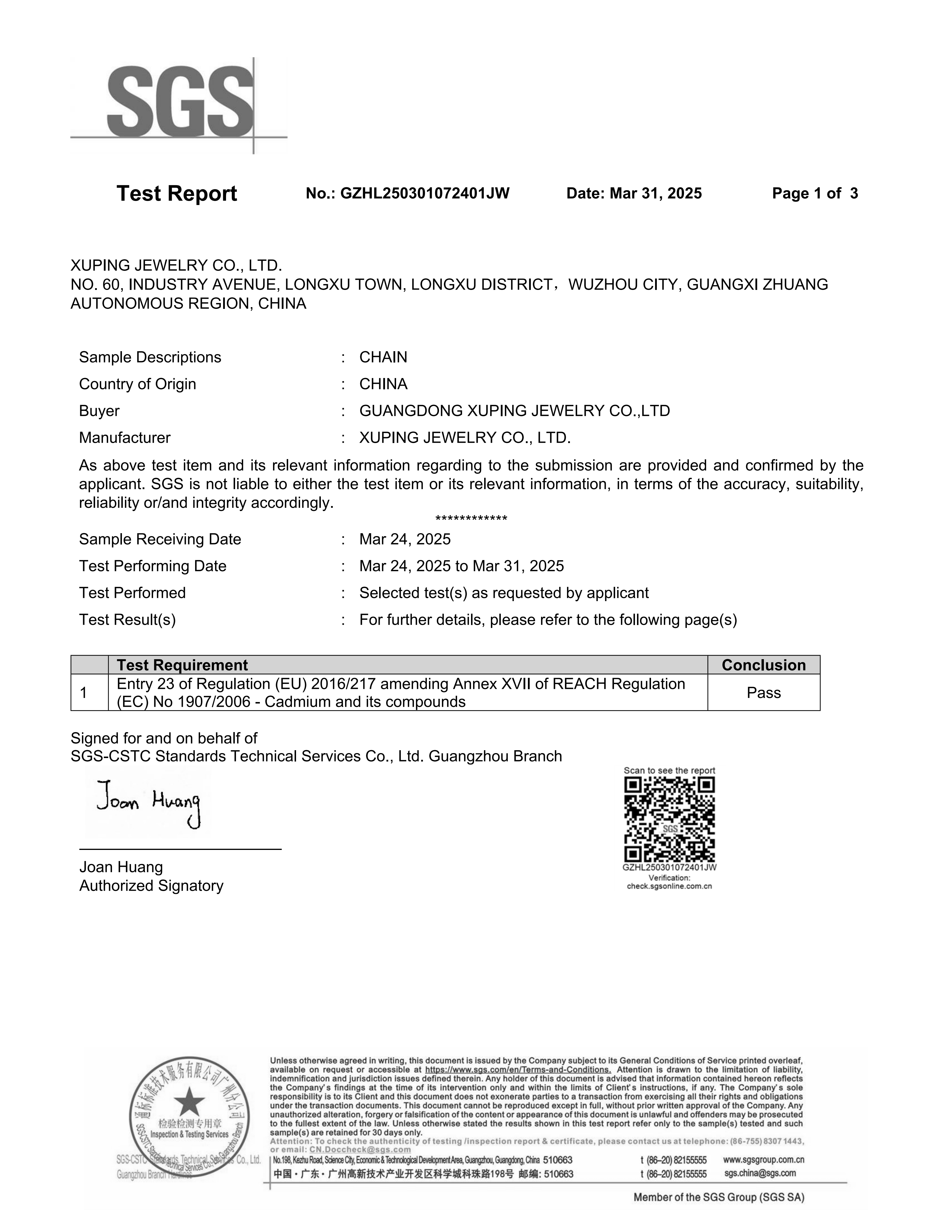
SGS test report GZHL250301072401JW, covering necklaces under REACH Regulation (EC) No 1907/2006, issued 2025-03-31.
FAQ
When does a “14K gold color” plating description become a false gold claim in the United States?
Under the FTC Jewelry Guides at 16 CFR Part 23, it is unfair or deceptive to misrepresent the presence, quantity or karat fineness of gold or gold alloy in a jewelry product. The revised guidance retains the earlier reference thresholds used to describe gold plated or gold electroplated products: a 10K minimum fineness and a 0.175 micron coating thickness. A buyer placing “14K gold color” on an order should therefore require the supplier to state base metal, plating composition and plating thickness in writing, rather than relying on the color descriptor alone.
What evidence shows a wholesale supplier can hold these specifications across a bulk order?
The evidence is documentary and process-based. Xuping Jewelry reports 194 patents and an R&D team of 62 designers, operates 18 production procedures with 100% full inspection, holds SGS, CE and ISO certification, and reports a monthly capacity of 8,000,000 pieces. The documents should be matched to the actual product line rather than accepted as a general factory level: SGS report CANHL25006144001 covers REACH Regulation (EC) No 1907/2006 with validity from 2025-03-27 to 2030-03-27, SGS report CANHL25006145601 references IEC 62321-7-1:2015, CTI certificate A2230517570101001 covers IEC 62321-5:2013 and related standards valid to 2028-10-13, and ISO 9001 certificate CACQ21Q00750R1 covers design and production of metal jewelry with validity to 2027-10-25.
What budget level is needed to test a specification-driven wholesale program?
Xuping Jewelry publishes a minimum order value of USD 50, and lists a minimum order quantity starting at 1 piece within its production capability data. That threshold supports a small verification assortment rather than a full range rollout. Buyers should treat the entry value as a gate for testing and keep unit economics, plating specification and stone cost as separate line items in the quotation, since the minimum order value does not describe per-unit pricing.
How should a buyer verify plating, stones and dimensions before the bulk order?
Order a sample and audit it against the catalog line item by line item. Stainless steel necklace A00902945 is a useful reference because it specifies almost every field: stainless steel base metal, 14K gold color plating, 400 × 1 mm with a +60 mm extension, no stone, and about 6.30 g per piece. Each of those values can be checked with calipers and a scale. The same method applies to set X001006294, where the earring, pendant and bangle dimensions and the ±2 cm tolerance are all individually stated, and to earrings 14E25011845 at 8.88 g per pair.
What lead time should a buyer plan for a wholesale jewelry order?
Xuping Jewelry lists a production lead time of 30–90 days, against a monthly capacity of 8,000,000 pieces. The range reflects order structure and customization scope rather than a fixed schedule, so buyers should plan retail calendars against the upper end and reserve the lower end for repeat orders on unchanged specifications. Export operations cover more than 100 countries, with core markets including the United States, Mexico, Spain, Canada, Germany, France, Italy, the United Kingdom, Australia, Turkey, Saudi Arabia, the UAE and Poland. To confirm lead time for a specific SKU and plating specification, buyers can request a quotation or sample through wlwf@xuping.com.cn or WhatsApp +86 139-2505-0911 before placing the order.
Conclusion: The Spec Block Is the Contract
Stainless steel and environmental copper are not competing answers to the same question. They produce different weights at different dimensions, accept different plating conventions, and suit different retail positions. Necklace A00902945 at about 6.30 g in a one-millimeter stainless steel chain and necklace 14N245402 at 49.44 g in a six-millimeter environmental copper body are both correct — for different buyers.
The discipline that separates a routine order from a reorder is the same in both cases. Write the six fields down. Require the tolerance to name its component. Require the unit weight to name its unit. Require the plating description to survive a compliance review. Require a certificate number that matches the product line.
Guangdong Xuping Jewelry Co., Ltd. has manufactured fashion-imitation jewelry since 1997 from Guangzhou, China, and currently ships to more than 100 countries, supported by 194 patents, a 62-designer R&D team and a monthly capacity of 8,000,000 pieces. Catalog specifications, certificate numbers and production records are available on request through www.xupingjewelry.com.
Next Step
Send a target SKU, a required plating description and a destination market. Xuping Jewelry will return a written specification sheet with base metal, plating, stone, dimension, tolerance and unit weight stated in the same format used in this guide, together with the matching test report reference.
Email: wlwf@xuping.com.cn | Tel / WhatsApp: +86 139-2505-0911
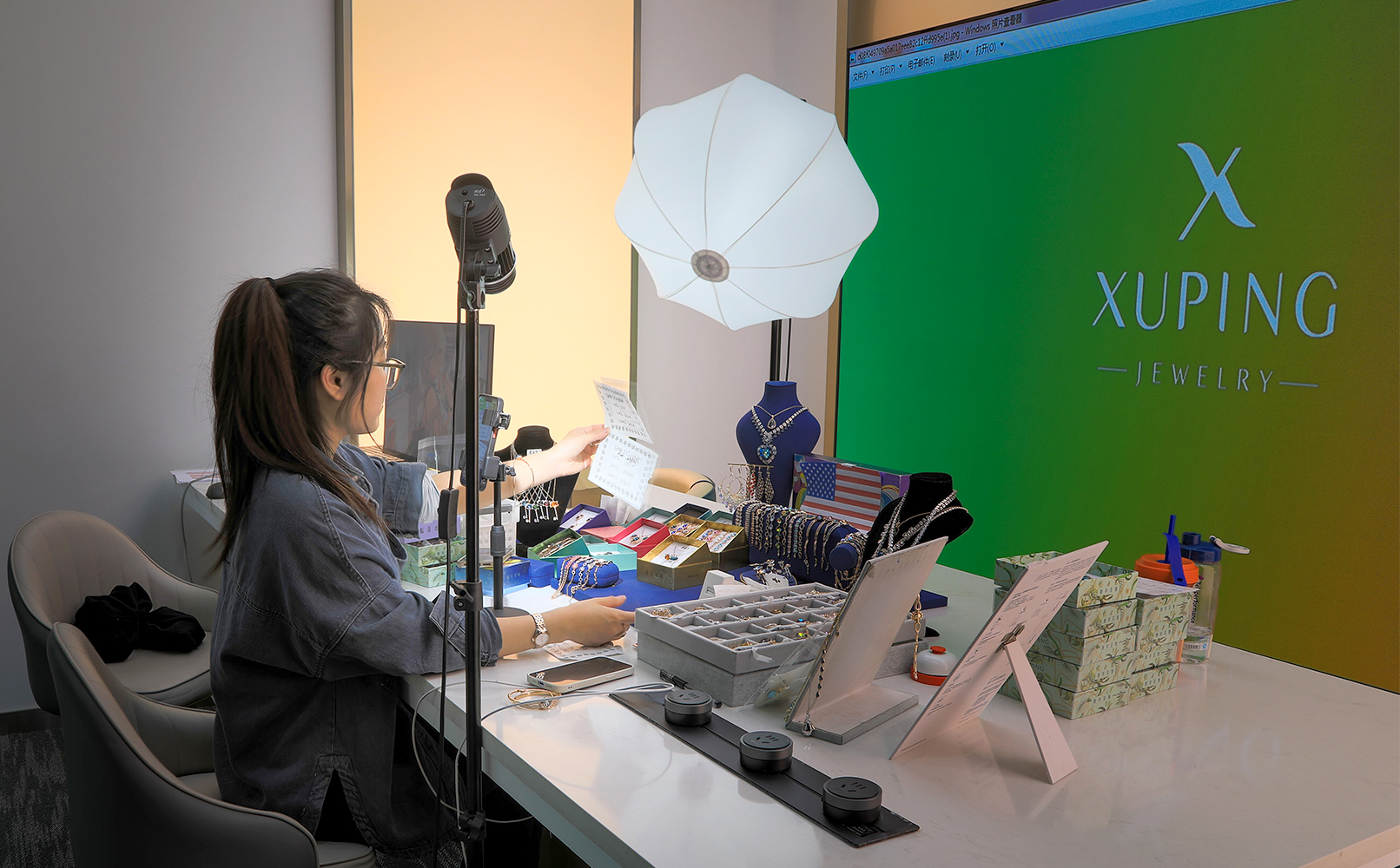
Guangdong Xuping Jewelry Co., Ltd. — 4th Floor, No. 28, Zhanqian Street, Zhanqian Road, Liwan District, Guangzhou, China.
How to Source Fashion Jewelry for Corporate Gifting
Related Article


